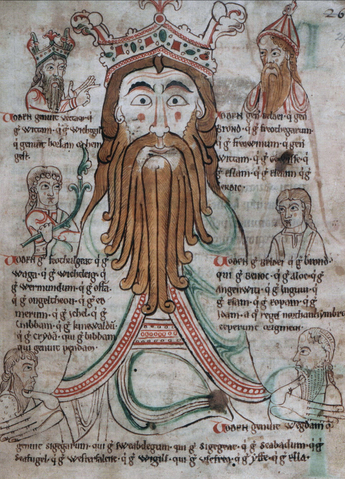
Scaefa (Old English) Scaefa, also spelled Scaef, Scef, was an ancient Lombardic King in English Legend.
According to his story, Sceafa appeared mysteriously as a child, coming out of the sea in an empty skiff. The name also appears in the corrupt forms Seskef, Stefius, Strephius. Though the name has historically been modernizes Shava (and latinized Scefius), JRR Tolkien used the correctly constructed modern English spelling Sheave.
Scyld Scefing
In Beowulf
Older than these is the Old English poem Beowulf which applies the story of the boy in the boat instead to the Danish who is the eponym of the legendary Danish royal lineage known as the Scyldings or Skjöldings. In the opening lines of Beowulf, Scyld is called Scyld Scefing, which might mean Scyld descendant of Scef, Scyld son of Scef, or Scyld of the Sheaf.[5] The Beowulf poet does not explain. But after relating in general terms the glories of Scyld's reign, the poet describes Scyld's funeral, how his body was laid in a ship surrounded by treasures, the poet explains:
Older than these is the Old English poem Beowulf which applies the story of the boy in the boat instead to the Danish who is the eponym of the legendary Danish royal lineage known as the Scyldings or Skjöldings. In the opening lines of Beowulf, Scyld is called Scyld Scefing, which might mean Scyld descendant of Scef, Scyld son of Scef, or Scyld of the Sheaf.[5] The Beowulf poet does not explain. But after relating in general terms the glories of Scyld's reign, the poet describes Scyld's funeral, how his body was laid in a ship surrounded by treasures, the poet explains:
They decked his body no less bountifully
with offerings than those first ones did
who cast him away when he was a child
and launched him alone out over the waves.[6] No other source relates anything similar about Scyld/Skjöld, so it cannot be known whether this is a case of similar stories being told about two different heroes or whether originally separate figures have been confused with one another.